Showing posts with label michigan. Show all posts

Monday, September 10, 2012

Garden Update - With Photos!

September is quickly settling in at the garden, 
and with it comes lots of busy work and plenty of good food.

Sean and the guys finished fencing in our new lot,
and our water storage solutions are working well.

The parsnip seeds I "saved" have germinated,
I'm sore from crouching over the parsnip bed,
thinning out the many extra sprouts.

This summer, Poppin' Fresh has DOUBLED in size, 
after we acquired the lot to our north. 
We may soon make use of the lot to the south, too.

Word of the Learning Leaves gardens spreads slowly, 
and we've had some great new gardeners at the work parties!


A view from behind the hoop house.

Gorgeous onion blossoms!
Our repurposed baby crib, lending support to tasty green beans.
We have over a dozen varieties of tomatoes ripening!
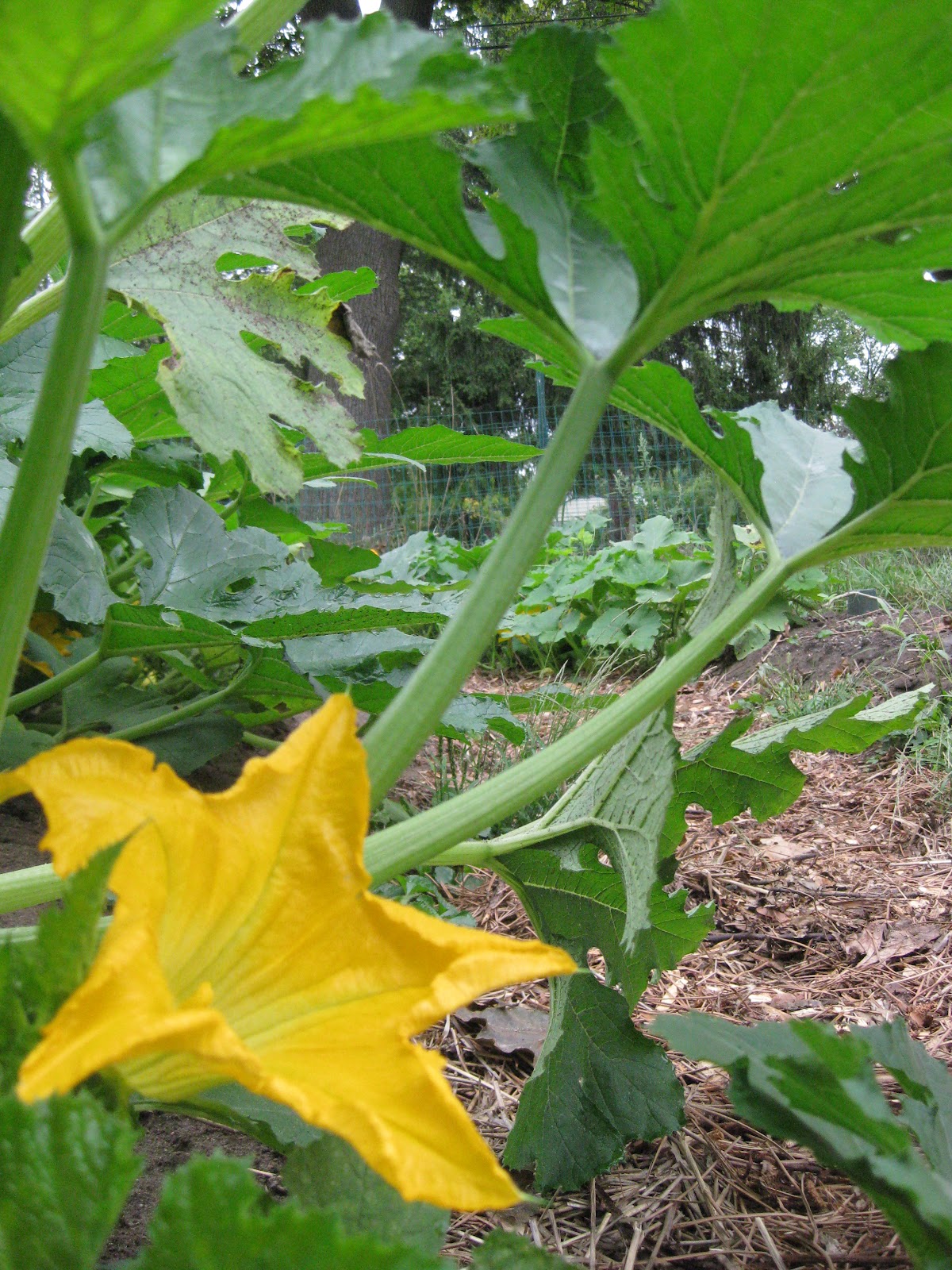
Squash blossoms abound!
The squash are coming in fast and furiously.
Here's our stunted corn - mostly for decoration this year.
The rabbits love dandelions!

"Thing 1" can pack away a pile of dandelions in just a few minutes.

This spooky spider lives near the rabbit hutches.

Tuesday, August 7, 2012

Living Within the Seasons - Buying in Bulk to Preserve Fruits and Vegetables

Where have I been, you ask?
 It's summer. I've been busy!
 Here's why...


Sean and I are taking part in a grand life experiment, in which we eat lots of organic, locally grown food throughout the year. Most folks think that we're a little bit "funny" for opting to live and eat within the seasons. If you think about it, though, living within the growing cycle is how humans survived and stocked their pantry (and ice house, and spring house) for centuries.

Our process is simple.

Over the last few years we've formed great relationships with a number of local farmers and farmer's markets in the Lansing area. All you have to do is be a friendly customer, and you'll reap the rewards! When a crop is ripe for the picking, we buy a few bushels (on average) at a great bulk price from one of these local growers.

There's no way we could eat a bushel or two of cucumbers before they go bad, so Sean and I preserve the over-abundance to enjoy for the rest of the year. It's may seem like a lot of work, but it's well worth it. The food always tastes better than what you'd find in the grocery store, and it's healthier and cheaper.

We preserve our food in a few different ways. The three main methods are canning, dehydrating and freezing. (We also dabble in lacto-fermentation, but that's a story for another day.)

Every vegetable and fruit has a preferred preservation method.

It's easiest to dehydrate squash and zucchini, which will keep for about a year. You can also dehydrate peppers, tomatoes, strawberries, apples, venison and beef jerky and a myriad of other tasty treats. Dehydrated vegetables are great to cook with, and are extra-delicious in stir fry, soup and sauces.

Never, ever try to dehydrate raspberries or blackberries. We learned this the hard way, and they turned into crunchy, crispy little nuggets. It was like eating a bug's cocoon. 

With ample freezer space, you can freeze just about anything. Strawberries, asparagus and corn are relatively easy to freeze, and they keep for at least a year. Another neat trick is to cook dishes and soups in BIG batches, and freeze the left-overs. If you cook a big pot of cream of asparagus soup, for example, you'll have enough left over for soup and sandwiches in the winter.

Blueberries are easy - you just toss them in a gallon-size freezer bag and tuck it into your icebox. Or, you can vacuum seal them. Don't bother rinsing the blueberries before freezing, as that will wash away their natural wax-like coating. (Rinse them before you eat or cook with them, though!)

You can also save food in glass jars, which is called "canning". To be honest, canning is my least favorite method of preservation. I just can't get excited about sweating over a big pot of boiling water. Still, it's worth the hard, hot work. Tomatoes, green beans, pickled cucumbers,  jellies and jams are commonly canned. Meats, homemade soup and other strange things can also be canned, but that requires a pressure canner.

Right now, it's cucumber season.
We've been pickling.

Sean and I have spent many a romantic evening in our kitchen, this month. There were no lit candles, but we cranked up the classical music while we sweating over our cans (and cans, and cans!) of pickled cucumbers.

Also, it's zucchini season. Green pepper season, too. And green beans. It's nearly tomato season, and it would be corn season if we'd gotten more rain.

If you think we're nuts for doing all of this hard work, you're not alone.

Most of our friends view us with a mixture of skepticism and awe (but mostly skepticism) when the conversation circles around to our strange food practices. We're not ashamed of it. In fact, we're pretty darn proud, but we tend to keep quiet about it because we feel as though we're bragging when we list off the benefits of our proclivity to preserve.

We're not the only food savers in town. Today at Curious I talked with my new friend Ken, a fellow pickle lover and novice canner. We bragged to one another about our freezers full of Michigan blueberries and the benefits of a probiotic diet. Bonding with a stranger over the joys of preserving food helped me gain confidence, and convinced me that what Sean and I are doing isn't completely insane.

If you think you're up for a rewarding challenge, I'd be pleased as punch to answer your questions.

If you want to jump in feet first... STOP!

First, do some research. Make sure you're going about this the right way. If you don't know what you're doing, you'll likely lose all of that fresh food you want to save.  

Courtesy of U-Pick.org

Thursday, July 5, 2012

Feeling Fruity: Michigan U-Pick Experiences

In the past month, Sean and I have picked fruit at three very different U-Pick operations in Mid-Michigan.

We picked strawberries at a large production farm, blueberries at a popular cider mill and entertainment-focused farm, and currants from a back yard garden in Lansing. At each location the end result was fresh, delicious fruit that costs far less than buying lesser-quality fruit from the grocery store or farmers' market.

Strawberry Picking at Felzke Farms
Some weeks ago, Sean and I had the good fortune of finding ourselves in the best strawberry plot at  Felzke Farms. It was hot out, but I was glad of my long pants while I crawled between the rows. Felzke Farms is Michigan's largest strawberry producer, and has been a local U-Pick favorite for years. Sean and I had done some reconnaissance while buying 20 lbs of asparagus in the spring, so we knew what we were up against.

We arrived relatively early - around 9 a.m. - and were the last people to score a spot in the BEST strawberry field at Felzke (according to the lovely librarian picking a few rows over). I have never tasted a better strawberry. I know this doesn't sound like a big deal, but man, these strawberries can change your perspective on life.

About an hour in the field earned us roughly 40 lbs of the ripest, reddest, juiciest Michigan strawberries on the face of the planet (probably). We dehydrated some to put in granola and oatmeal, made a big batch of strawberry jam and froze the rest. Sucking on a frozen strawberry is one the best ways to combat this outrageously dry, hot summer.

Felzke Farms is a production farm, first and foremost. They offer U-Pick strawberries on the side because they have an abundance of strawberries, and there are crazy people like us who are willing to PAY the farm to pick their berries. It's a good deal for the farm, and a good deal for us! These strawberries are WAY better than those we bought by the quart-full from Kroger 2 years ago, or the farmers' market last year. Cheaper, too.

Blueberry Picking at Uncle John's Cider Mill
 The 6-foot blueberry bushes were drooping from the weight of countless ripe berries when we pulled up to the U-Pick field last Sunday. It was a steamy afternoon - about 90 degrees - and we were the only folks there. We bought a pre-paid 10 pound U-Pick box (about $25). An hour later it was overflowing with the best blueberries I've ever tasted!

We've stocked ourselves with delicious blueberry jam, dried blueberries to snack on, frozen blueberries for my oatmeal and a few cans of berries to bake with over the next year. Last night's blueberry crumble was a beautifully violent purple-blue hue that stained our mouths. Yum!


Of course, you don't HAVE to slave away in the sun to get lots of berries for a good price. At Uncle John's you can buy a pre-filled 10 lbs. box for $25 - way cheaper than the grocery store or farmer's market. We opted to pick our own because we like it, and because the berries taste better if you work a little harder for them. The pre-filled boxes are not as fresh, but still a great deal.

Uncle John's is primarily an entertainment location and cider mill, not a production farm like Felzke. They boast sprawling orchards, a winery, a pie house, delicious donuts and cider, U-Pick pumpkins, a fun corn maze and all sorts of family-friendly attractions. They've recently expanded to offer blueberries, asparagus and strawberries to keep people coming in the mill's "off-season". It's working!

Currant Picking in Old Town, Lansing
Sean and I spent our Independence Day morning in Old Town at our friend Lisa's home, picking eight pounds of currants. I love picking currants. Currant bushes don't grow quite as tall as blueberry bushes, but they provide ample shade as I root around, plucking their fruits. Have you ever seen fresh currants? They're lovely little red gems strung together in a way similar to grape bunches.


Picking currants at Lisa's was a significant moment for the two of us - an anniversary, of sorts. Last summer we experienced our first Picking excursion in this very same same back yard on the Grand River. It was hot and dirty work, and I did not enjoy myself. Still, it held a special charm, and the fruits of our labor (pun-tastic!) were well worth a sweaty hour or two. We juiced our berries with various devices, and they will soon become clear, tasty currant jelly.

Lisa is the opposite of massive operations like Felzke Farms and Uncle John's. She's an regular person with a job and a life... a big, back-yard garden. She planted a row of currant bushes years ago, and each season she allows strangers (like us) to come and pick them for a very low price.  It's easy for her, easy for us, and we both benefit.


Since picking currants last summer, we've harvested apples from Clam Lake Orchard (near Torch Lake), a few bushels of huskcherries from Pregitzer Farm, wild raspberries from the areas surrounding "Barton's Blind", a gorgeous Douglas Fir Christmas tree at Peacock Road Tree Farm, the aforementioned strawberries, blueberries, currants and countless other crops from our own gardens.

It's pretty cool, to say the least.

Wednesday, December 28, 2011

Pragmatism and "The Sane Society" by Erich Fromm


I finished up the following transcription of Fromm's piece while listening to On Point. Their discussion of pragmatism, our current society and political climate, and the works of William James (!!!) was excellent and deserves attention from all! Their guest was the editor of the newly-released The Heart of William James, Professor Robert D. Richardson. I was first introduced to William James and Pragmatism as a freshman majoring in English. It's partly what led me to becoming a history major, and is one of very few "old college books" that I continuously keep at the ready, rather than in a box in the "Book Closet."

I have a Book Closet. I should explain that at some point.

The following is from Erich Fromm's The Sane Society. It's been on my mind lately, as well as some writings by Eric Hoffer and, now, William James.  Fromm was a celebrated German-born American psychoanalyst, social philosopher and author.

I realize that this is a lot to read, especially on a computer screen. I've taken the liberty of BOLDING some passages I found especially important or thought provoking. The italics are Fromm's own. This was first published in 1955, but barely shows its age. Let me know if you find any typos.

Why did I do this?
Because I believe that it's important.
This isn't the first time I've done this sort of thing.
 Erich Fromm
______________________________________________

In building the new industrial machine, man became so absorbed in the new task that it became the paramount goal of his life. His energies, which once were devoted to the search for God and salvation, were now directed toward the domination of nature and ever-increasing material comfort. He ceased to use production as a means for a better life, but hypostatized it instead to an end in itself, an end to which life was subordinated. In the process of an ever-increasing division of labor, ever-increasing mechanization of work, and an ever-increasing size of social agglomerations, man himself became a part of the machine, rather than its master. He experienced himself as a commodity, as an investment; his aim became to be a success, that is, to sell himself as profitably as possible on the market. His value as a person lies in his salability, not in his human qualities of love, reason, or in his artistic capacities. Happiness becomes identical with consumption of newer and better commodities, the drinking in of music, screen plays, fun, sex, liquor and cigarettes. Not having a sense of self except the one which conformity with the majority can give, he is insecure, anxious, depending on approval. He is alienated from himself, worships the product of his own hands, the leaders of his own making, as if they were above him, rather than made by him. He is in a sense back where he was before the great human evolution began in the second millennium B.C.

He is incapable to live and to use his reason, to make decisions, in fact incapable to appreciate life and thus ready and even willing to destroy everything. The world is again fragmentalized, has lost its unity; he is again worshiping diversified things, with the only exception that now they are man-made, rather than part of nature.

The new era started with the individual initiative. Indeed, the discoverers of the new worlds and sea lanes in the sixteenth and seventeenth centuries, the pioneers of science, and the founders of new philosophies, the stattesmen and philosophers of the great English, French and American revolutions, and eventually, the industrial pioneers, and even the robber barons showed marvelous individual initiative. But with the bureaucratization and managerialization of Capitalism, it is exactly the individual initiative that is disappearing.

Bureaucracy has little initiative, that is its nature; nor have automatons. The cry for individual initiative as an argument for Capitalism is at best a nostalgic yearning, and at worst a deceitful slogan used against those plans for reform which are based on the idea of truly human individual initiative. Modern society has started out with the vision of creating a culture which would fulfill man's needs; it has as its ideal the harmony between the individual and social needs, the end of the conflict between human nature and the social order. One believed one would arrive at this goal in two ways; by the increased productive technique which permitted feeding everybody satisfactorily, and by a rational, objective picture of man and of his real needs. Putting it differently, the aim of the efforts of modern man was to create a sane society. More specifically, this meant a society whose members have developed their reason to that point of objectivity which permits them to see themselves, others, nature, in their true reality, and not distorted by infantile omniscience or paranoid hate. It meant a society, whose members have developed to a point of independence where they know the difference between good and evil, where they make their own choices, where they have convictions rather than opinions, faith rather than superstitions or nebulous hopes. It meant a society whose members have developed the capacity to love their children, their neighbors, all men, themselves, all of nature; who can feel one with all, yet retain their sense of individuality and integrity; who transcend nature by creating, not destroying.

So far, we have failed. We have not bridged the gap between a minority which realized these goals and tried to live according to them, and the majority whose mentality is far back, in the Stone Age, in totemism, in idol worship, in feudalism. Will the majority be converted to sanity - or will it use the greatest discoveries of human reason for its own purposes of unreason and insanity? Will we be able to create a vision of the good, sane life, which will stir the life forces of those afraid of marching forward? This time, mankind is at one crossroad where the wrong step could be the last step.

In the middle of the twentieth century, two great social colossi have developed which, being afraid of each other, seek security in ever-increasing military rearmament. The United States and her allies are wealthier; their standard of living is higher, their interest in comfort and pleasure is greater than that of their rivals, the Soviet Union and her satellites, and China. Both rivals claim that their system promises final salvation for man, guarantees the paradise of the future. Both claim that the opponent represents the exact opposite to himself, and that his system must be eradicated - in the short or long run - if mankind is to be saved. Both rivals speak in terms of nineteenth-century ideals. The West in the name of the ideas of the French Revolution, of liberty, reason, individualism. The East in the name of the socialist ideas of solidarity, equality. They both succeed in capturing the imagination and the fanatical allegiance of hundreds of millions of people.
. . .
But without ignoring the tremendous differences between free Capitalism and the authoritarian Communism today, it is shortsighted not to see the similarities, especially as they will develop in the future. Both systems are based on industrialization, their goal is ever-increasing economic efficiency and wealth. They are societies run by a managerial class, and by professional politicians. They both are thoroughly materialistic in their outlook, regardless of Christian ideology in the West and secular messianism in the East. They organize man in a centralized system, in large factories, political mass parties. Everybody is a cog in the machine, and has to function smoothly. In the West, this is achieved by a method of psychological conditioning, mass suggestion, monetary rewards. In the East by all this, plus the use of terror. It is to be assumed that the more the Soviet system develops economically, the less severely will it have to exploit the majority of the population, hence the more can terror be replaced by methods of psychological manipulation. The West develops rapidly in the direction of Huxley's Brave New World, the East is today Orwell's "1984." But both systems tend to converge.
 . . .
In the development of both Capitalism and Communism we can visualize them in the next fifty or a hundred years, the process of automatization and alienation will proceed. Both systems are developing into managerial societies, their inhabitants well fed, well clad, having their wishes satisfied, and not having wishes which cannot be satisfied; automatons, who follow without force, who are guided without leaders, who make machines which act like men and produce men who act like machines; men, whose reason deteriorates while their intelligence rises, thus creating the dangerous situation of equipping man with the greatest material power without the wisdom to use it.

The alienation and automatization leads to an ever-increasing insanity. Life has no meaning, there is no joy, no faith, no reality. Everybody is "happy" - except that he does not feel, does not reason, does not love.

In the nineteenth century the problem was that God is dead; in the twentieth century the problem is that man is dead. In the nineteenth century inhumanity meant cruelty; in the twentieth century it means schizoid self-alienation. The danger of the past was that men became slaves. The danger of the future is that men may become robots. True enough, robots do not rebel. But given man's nature, robots cannot live and remain sane, they become "Golems," they will destroy their world and themselves because they cannot stand any longer the boredom of a meaningless life.

Our dangers are war and robotism. What is the alternative? To get out of the rut in which we are moving, and to take the next step in the birth and self-realization of humanity. The first condition is the abolishment of the war threat hanging over all of us now and paralyzing faith and initiative. We must take the responsibility for the life of all men, and develop on an international scale what all great countries have developed internally, a relative sharing of wealth and a new and more just division of economic resources. This must lead eventually to forms of international economic cooperation and planning, to forms of world government and to complete disarmament. We must retain the industrial method. But we must decentralize work and state so as to give it human proportions, and permit centralization only to an optimal point which is necessary because of the requirements of industry. In the economic sphere we need co-management of all who work in an enterprise, to permit their active and responsible participation. The new forms for such participation can be found. In the political sphere, return to the town meetings, by creating thousands of small face-to-face groups, which are well informed, which discuss and whose decisions are integrated in a new "lower house." A cultural renaissance must combine work education for the young, adult education and a new system of popular art and secular ritual throughout the whole nation.

Our only alternative to the danger of robotism is humanistic communitarianism. The problem is not primarily the legal problem of property ownership, nor that of sharing profits; it is that of sharing work, sharing experience. Changes in ownership must be made to the extent to which they are necessary to create a community of work, and to prevent the profit motive from directing production into socially harmful directions. Income must be equalized to the extent of giving everybody the material basis for a dignified life, and thus preventing the economic differences from creating a fundamentally different experience of life for various social classes. Man must be restored to his supreme place in society, never being a means, never a thing to be used by others or by himself. Man's use by man must end, and the economy must become the servant for the development of man. Capital must serve labor, things must serve life. Instead of the exploitative and hoarding orientation, dominant in the nineteenth century, and the receptive and marketing orientation dominant today, the productive orientation must be the end which all social arrangements serve.

No change must be brought about by force, it must be a simultaneous one in the economic, political and cultural spheres. Changes restricted to one sphere are destructive of every change. Just as primitive man was helpless before natural forces, modern man is helpless before the social and economic forces created by himself. He worships the works of his own hands, bowing to the new idols, yet swearing by the name of the God who commanded him to destroy all idols. Man can protect himself from the consequences of his own madness only by creating a sane society which conforms with the needs of man, needs which are rooted in the very conditions of his existence. A society in which man relates to man lovingly, in which he is rooted in bonds of brotherliness and solidarity, rather than in the ties of blood and soil; a society which gives him the possibility of transcending nature by creating rather than by destroying, in which everyone gains a sense of self by experiencing himself as the subject of his powers rather than by conformity, in which a system of orientation and devotion exists without man's needing to distort reality and to worship idols.

Building such a society means taking the next step; it means the end of "humanoid" history, the phase in which man had not become fully human. It does not mean the "end of days," the "completion,", the state of perfect harmony in which no conflicts or problems confront men. On the contrary, it is man's fate that his existence is beset by contradictions, which he has to solve without ever solving them.When he has overcome the primitive state of human sacrifice, be it in the ritualistic form of the Aztecs or in the secular form of war, when he has been able to regulate his relationship with nature reasonably instead of blindly, when things have truly become his servants rather than his idols, he will be confronted with the truly human conflicts and problems; he will have to be adventuresome, courageous, imaginative, capable of suffering and of joy, but his powers will be in the service of life, and not in the service of death. The new phase of human history, if it comes to pass, will be a new beginning, not an end.

Man today is confronted with the most fundamental choice; not that between Capitalism or Communism, but that between robotism (of both the capitalist and the communist variety), or Humanistic Communitarian Socialism. Most facts seem to indicate that he is choosing robotism, and that means, in the long run, insanity and destruction. But all those facts are not strong enough to destroy faith in man's reason, good will and sanity. As long as we can think of other alternatives, we are not lost; as long as we can consult together and plan together, we can hope. But, indeed, the shadows are lengthening; the voices of insanity are becoming louder. We are in reach of achieving a state of humanity which corresponds to the vision of our great teachers; yet we are in danger of the destruction of all civilization, or of robotization. A small tribe was told thousands of years ago: "I put before you life and death, blessing and curse - and you chose life." This is our choice too.
______________________________________________

Transcribed by me, from Fawcett's thirteenth printing (May 1965) 
of Erich Fromm's The Sane Society. Specifically, these passages 
are from Fromm's Summary, pages 309 - 315. 

Tuesday, November 22, 2011

"Life Lessons in Simplicity, Service and Common Sense""

A great debate has been raging in recent years about how to
improve our schools. I believe all good schools must recognize that the
moral growth of students is at least as important as their intellectual growth.

That's what some educators mean when they say that the only
proper education is amoral education - which is
not to be confused with a sectarian education.

The goal of Quaker teachers is to imbue students with the desire
to let their lives speak when they graduate and enter the adult world.
Non-Quaker educators express the same view somewhat differently
when they proudly describe a former student as a productive and
useful member of society, an exemplary parent, a warm and responsive
human being, an altruist. We can't simply focus on turning out
academically well-prepared graduates who will be accepted at the
colleges of their choice or enter the workforce with
excellent prospects for advancement.

Formal education is only a jumping-off point for a lifetime of learning and doing,
and what concerns good schools and good teachers is how
students apply the learning they acquire to living their lives.

From Robert Lawrence Smith's A Quaker Book of Wisdom (1998)


Smith's book has been floating around the house for the past few months,
and every time I pick it up I find little golden gems of truth and sensibility that
I find even more special and inspiring as the year winds down to a close.

Right before we left for the cabin (literally, while the guys were packing the truck)
I decided to dismantle the living room in preparation for the holidays.
I had tricked it out thoroughly with little gourds and pretty goldenrod
and other harvest-ish things. When we got home from the cabin, I came to
the sudden and horrifying discovery that we have pretty much zero
holiday decorations. We used to have loads... but I just can't find them.
So, we're back to a bare walls and a sad-looking mantle for the interim.

Our trip Up North was fun! The goal was to come home with a few
deer to eat for the next 12 months. Three experienced hunters, in blinds,
with bait apples and de-scenting spray... and the most exciting thing spotted
was a lone turkey. Just two days before on the same land some friends bagged
two does and a buck, so we know they're out there. Somewhere.

We hit up Shorts Brewery, in Mancelona, on Friday night. SO COOL!
I loved their sample paddles. For about $8 you can choose 5 beers
from their list of 20 or so. The Bourbon Wizard is not my friend,
but their grape juice based "Da Vine" was delicious!

We're headed back up right after Turkey Day lunch in Williamston
for Bag Some Deer, Round Two! We're also on the look-out for
Christmas trees and decorations, as well as some cheap land
on which to build our dream compound.

Here are just a few photos from when Sean and I went to
Elk Rapids on Saturday.


(If anyone can make these last two crazy shots into
an epic .gif, PLEASE DO SO. Then, send it to me. Please.)

EDIT - Blahhh! The centering/spacing is all off. I don't feel like fixing it again.
Sorry if it loads for you like it did for me.
Hopefully, your browser is better/smarter/faster/stronger.

Tuesday, October 18, 2011

Soaking up the last warm days of summer in Lansing

A little photo-journal entry of our weekend:


Sean made this awesome tree sculpture last winter.
It's made of left-over chicken wire bits, and a bit of unexpected nature.


The lovely blue flowers I nearly killed (4 times)
are the prettiest thing in our garden!


Then, we biked from our house to the fish ladder in Old Town!

The River Trail was busier than expected, as was the fish ladder.
I saw a few father/son duos fishing in the Grand,
a lone woman happily kayaking,
lenty of locals soaking up the sun at the
Lansing City Market's Waterfront Bar & Grille.


I had never been, and it was WAY larger and more interesting than I expected.
Maybe next year we'll get there while the fish are still hopping.


A view from the observation deck ... and Sean's new crosstrail!


Sunday, December 5, 2010

Sherlock will save us all.

This Article is where it began, for me.

I've never read the Sherlock Holmes stories. It's been especially hard to ignore them at work. Shame floods over me every time Doyle and his creation are mentioned. I should read those! I should have read them, already! How did I miss this?!

My knowledge of Sherlock consists of what I've gleaned from the general media, studying other Victorian writers, Disney's The Great Mouse Detective, and the second half of that recent Sherlock Holmes movie starring Robert Downey Jr. That's not much, and not canon at all.

While I don't know much about Mr. Holmes, I do know a fair amount about the world and society in which he lived and died. Granted, it comes mostly from reading historical romance novels, but some of them are quite reputable! (See: Lauren Willig's Pink Carnation series.) It was a fascinating place and time quickly coming back into fashion. The increasing popularity of Victoriana is apparent in fashion, the rise of Steampunk (See: Off The Beaten Path Books, in Farmington.), a growing fear and distrust of modern and futuristic technologies, and nostalgia we feel for a time long before our own. Well, not so long...

Maybe our next craze won't be about wizards or werewolves or zombies or the Chinese. Maybe we'll look back on history, rather than buy into myths, superstitions and fear. Maybe we'll make shining examples of strong-willed, intelligent, independent thinkers who helped to shape a better world. Whether they be characters like Mr. Holmes or "real" (our perceptions of) people Queen Victoria bothers me not. ( I've also noticed an influx of books, new and reissued, about Victoria. Here, here, and here. You're welcome.)

So, I shall wait and see what happens. Maybe I'm not the only one realizing that we could be so much better, if only we tried. Until then, I'll do my part. Does anyone have a copy of Sir Arthur Conan Doyle's works I could borrow?

Friday, May 28, 2010

Giving up the Hard Juice

I'm writing to you today from Command Central, the newest technology hub in East Lansing! Alright, so it's technically a glorified computer desk with a television atop the highest shelf. But, hey, at least it's got internet and cable. It boasts cool, below-ground temperatures... in my basement.

Everyone needs to begin somewhere.

Sean and I are embarking on a new challenge. Taking it a week at a time (my caveat), we'll attempt to stop eating out. No big deal, right? Sean's a thrifty, creative and talented cook, so we'll have plenty of meals and leftovers to carry us through. In that respect, the hard work is already done. Still, we spend a lot of time and money "eating out" around town. Dominos is across the street from us. Quality Dairy (which is considered an eating establishment in this experiment) is a block away. I walk to work on a path which parades me past two coffee shops and a myriad of local restaurants and bars. When we're on the other side of town we like to stop at Culver's (*shudder*) or Cracker Barrel.

I don't know if this will work.

I drink a lot of coffee. I'm fine with giving up restaurant eating, especially fast food. It's the loss of COFFEE that I fear will be my downfall. True, we have a good (semi-broken) coffee pot and a sporadic supply of delicious fair trade coffee beans that my dad imports green and roasts at home, from Sweet Maria's. And yes, there's a free supply of coffee at the bookshop, as well. I can manage to get from our home to the shop without visiting any of East Lansing's fine coffee establishments. I think.

I know Ellen from Grand River Coffee better than I know my neighbors. I met Bob Fish, American hero and co-creator of Beaners (Biggby Coffee), and was starstruck. The average large coffee in this town costs $2.00. Two dollars for a cup of life-sustaining juice from magical beans, imported to Mid-Michigan from afar. Sold! Granted, more often than not I find myself clenching a more expensive drink than I expected to buy, but that's marketing! I'm an important part of the local coffee-buying population, and I'm throwing in the towel.

What we're not giving up are the drinking establishments of East Lansing. To the average 24 year old living in one of America's most alcohol-focused college towns, this is good news! I think I'd rather keep coffee and give up the spirits, though. Ah, well. At least I have Boobs and Beer, a Michigan brew blog, to keep me informed.

I made my own coffee this morning, but I'm going out to lunch with a friend this afternoon. Hey, we haven't started, yet!

Wednesday, May 26, 2010

A Less-Trampled Path

So here's the deal. I'm back to blogging again. And once again, I'm serious about it (haha). I think this time it might stick. True, I've said this before. There's truly only one way to find out.

Sustainability is quite the catch-phrase these days, in this post-millennial, greenified world. First there was Al Gore, then Elphaba. Next, Lady Gaga will premiere her new Lady Gaia costume and become the first (?) international Green Revolution icon. I was a history major. I know all about using the figure of a woman as the symbol of a true revolution. I'm down.

I'm so “down,” in fact, that I'm prepared to put it onto the vast Internetverse. I know that Blogs are rather Old-School. Still, I shall persevere. Given my circumstances, I'd consider this a rather advanced personal technological achievement. Don't mock me. Just keep reading!

In trying to trace the root of this sudden zeal, I realized a few of the doubtless numerous and otherwise unnoticed influences upon my life. My new husband, Sean, is something of a zombie aficionado. What began as a kitchy interest and collection theme has blossomed into a fully fledged state of paranoia regarding the (most definitely real) zombie apocalypse. I'm yet skeptical, but anything is possible. Or, maybe this sprouts from his interest in the spread of diseases and epidemiology.

He's truly not insane, I promise. Or, are we both?

We've both recently graduated. In college, I became very involved in things. I worked at the library and joined a few honors societies, which I had some part in governing. I was a bit of a departmental starlet, although it seems very awkward (yet right) to call myself so. Harlot, sometimes. I studied creative non-fiction under one of the most influential women of my life. I became the aforementioned history major, in addition to majoring in English. I was on the fast-track to a career in retail and freelance, most likely.

Goodness, how true it's become!

I started to make friends with a fascinatingly diverse group of people. I found the most excellent mentors and academics available, there. And even more – they're actually invested in their students as individuals and future colleagues. It was flattering, startling, and emboldening. I'm truly lucky/blessed/______ to have been where I've been.

It goes deeper and deeper, I'm realizing while I write and reminisce. I used to spend my playtime, nearly every day, outside under the Texas sun. My dad's a gardener. Really, each relative I'm fortunate enough to have has influenced me toward this in some way or another. Really, all of you. Thank you.

Ah, I'm rambling. If anyone cares about the rest of the story, comment one day far into the future and I'll tell you more. I don't have time to dawdle!

What's in the Green Bag:
- Obama Zombies: How the Liberal Machine Brainwashed My Generation, by Jason Mattera
- Deep Economy: The Wealth of Communities and the Durable Future, by Bill McKibben
(I found this through a recent NYTimes review of Eaarth, and am simply stunned by the number of things I do not know, or simply have not paused to consider!)
- The End of Nature, by Bill McKibben
- The Age of Missing Information, by Bill McKibben
- Green Guide: The Complete Reference for Consuming Wisely (endorsed by NatGeo)
- Worms Eat My Garbage, by Appelhof (Sean's book, and by a local author!)
- Watershed: The Undamming of America, by Elizabeth Grossman
- Meditations from the Mat, by Gates aand Kenison
- A Few Brass Tacks, by Louis Bromfield
(I just happened upon this at work, and was astounded by the "Apologia" at the beginning. I'll post a version of it soon!)
- The Sunflower Forest: Ecological Restoration and the New Communion with Nature, by William R. Jordan III
(Ecological Restoration. Now, why haven't I heard of THIS before?)
- August Celebration: A Molecule of Hope for a Changing World, by Linda Grovner
(Another wildcard find from The Curious Book Shop!)
- The Bill McKibben Reader: Pieces of an Active Life

One of my major problems is handling the barrage of information coming down all around me. Learning about so many new things at once is exhilarating and overwhelming. I'm coping with it in the only way I know how - by writing. My journal has become a good commonplace book over the last few weks, but I can recognize a situation which calls for a keyboard and forum.

The time, dear reader, is now.

Tuesday, February 3, 2009

Gov. Jennifer Granholm's State of the State Address


Michiganders love to complain about the state's infamously horrible roads. Full of tire-popping, crater-sized pot holes, the ribbons of highways that bisect and connect our state are falling to pieces, quite literally. However, the faulty roads have taken a back-seat in the media spotlight, which now shines blindingly on the newest fault - Michigan's struggling economy. Much like our roads, our economy and infrastructure are full of holes. Huge, gaping ones. Rather than a simple patch job, the rejuvenation of Michigan requires a full reconstruction and reformation. Michiganders also love to complain about construction, but this sort of work is needed. Under the leadership of Gov. Granholm, I think that we'll come out of this year with a good foundation laid. Soon, the Motor City and the state as a whole will be rolling along again.

This brings me to Gov. Granholm's "State of the State" address, which just aired. I have the utmost respect of Gov. Granholm, but I'll resist sounding like a fangirl...

"I will not sugar-coat the severity of the crisis," began the governor. Her hour-long speech overflowed with war-like vocabulary. Battle plans, soldiers, fighting for and protecting the "army of determined citizens" that make up Michigan. Allusions abounded. At first, I feared that her address would in fact be a lecture on nationalism. Fortunately, I was wrong.

The Granholm Administration's plan for reviving Michigan is a combination of job creation and the renewable energy industry. Over the last few years, Michigan's government has saved about $60 million in taxpayers' money by converting to more efficiency and green technologies. Some of these changes were as simple as screwing in better lightbulbs. This 23% cut is only the beginning. In Granholm's "45 by 20" goal, she has challenged the state to reduce their reliance on fossil fuel by 45% by the year 2020. The $2 billion that Michigan annually spends on importing coal from other states can go toward wind and solar power technologies within the state. "Energy entrepreneurs," she called us, as she outlined her plans for individuals to harness the power of sun and wind in their own homes and businesses - and profit by selling extra power back to the the power companies.

The push for a greener Michigan goes farther, and plays into job creation. Granholm proposed the creation of a new sort of CCC, where thousands of Michiganders would weatherize government buildings, research new technologies, and install them across the state. Referring to the impressive decrease in the government's reliance on fossil fuels, Granholm joked, "If government can do this, you can too."

The film industry was another star player in Granholm's address and plans for the future. Wonderstruck Animation, she announced, will be building a new studio in Detroit. Stardock, a gaming company, will set up in Plymouth. Motown Motion Pictures is moving into an old GM factory in Pontiac, bringing 3,600 new jobs to the area. Granholm made a special mention of her hopes to employ more of the "young creative workers" of Michigan through this new entertainment industry. I think she's on to something.

Reform, reform, reform. Don't get me wrong, I'm all for reforming the government and Michigan a whole. It's just that, well, I'm sure that every credible journalist will write an article or four about Granholm's reforms in the next week. I'll save myself the time of writing what everyone else is likely to focus on.

Granholm finished up with five "urgent measures" that she proposed to the state, as a whole.
  • Freeze tuition hikes, for the next academic year. (Oh, Gawd, yes. Please!)
  • For the legislature to pass the Home Foreclosure Prevention Act, giving homeowners 90 days to secure financing rather than have their own front doors slammed in their faces.
  • For public utilities to end shut-offs for the remainder of the winter, in the cases of seniors, the disabled, and homes with low or no income.
  • Freeze hikes in auto insurance rates for one year, allowing the current insurance reform to be proposed and passed. And, if a company refuses, Granholm called on her administration to use any and every tool in their possession to combat those heartless money-grubbing executives.
  • For the continued support of health care for those who are most in need. Don't strip people of their health care in an attempt to reduce spending!

I was thrilled to hear about Granholm's renewable energy plans for individuals to get involved, and possibly profit, from new technologies. Also, I have high hopes for Wonderstruck Animation in Detroit. With so many friends at CCS, how could I not be geeked about the possibilities of my sister, the animation student, finding a job in Michigan? One last point Granholm focused on, which thrilled me, is the "Buy Michigan First" initiative. "Support Michigan. Select Michigan. Buy Michigan," she pleaded. The more attention this cause gets, the better off we'll all be.