
At first glance, The End of Men sort of seemed like a woman who is trying too hard to sell herself. The book's cover is yellow and black (much like a caution sign) with bright pink lettering. It demands your attention, insistent that this book has something to say, and WANTS YOU TO LISTEN, RIGHT NOW.
When I received this book in the mail, I was concerned. It seemed... garish.
.
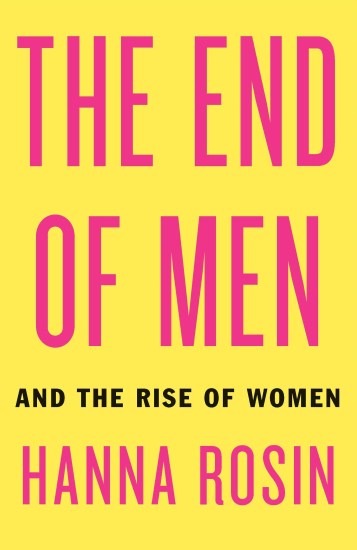
It's normal for me to be pulled into a conversation with a stranger about the book I'm reading. It happens often, and I suspect I give off some kind of "Talk to me - I like books!" vibe.
In general I read pretty "radical" books, but this was a new experience.
People felt compelled to comment on this book, and every opinion was different.
That, or they would just stare at me.

Imagine seeing someone reading this on the bus or subway.
Wouldn't you take a second glance?
It's not the content of this book that I appreciated so much as the conversations it inspired.
First, I showed it to a few of my male friends in their mid-twenties. "Take a look at this book," I said with a smile. "You should know what you're up against." They were not amused, mostly disinterested and shrugged it off immediately.
I was disapointed, so I decided to conduct an experiment.
I made a point of reading this book out in public.
Two older men, probably in their 60s, were the first to comment on the book's cover. One merely shrugged and shook his head. The other jumped about, too aggravated to stand still. I tried to explain the basic premise of the book, but he wasn't interested. Instead, he began quoting the Bible, insisting that because Adam came before Eve, we would never live in a world without men.
I shrugged him off as a lost cause, but his outburst caught the attention of a few younger guys. One, a grad student, shared a knowing smile with me. He asked about the author, and I mentioned Rosin's 2010 article with the same title.
A second guy, wearing huge black framed glasses and an immaculate, "cool" outfit, asked if the book talked about women and increasing aggression towards men and other women. Short answer: Yes.
After explaining how I came by the book, and that I was an independent reviewer, they were more enthusiastic about talking with me. I held the book out to them, but neither wanted to take a closer look.
The third guy was a young father, employee of the State of Michigan and an immigrant from India who shared stories about his aggressive two-year-old daughter. He seemed quite interested in the book, and flipped through it before handing it back.
We four talked about the book a bit more, then the young father asked me point blank : "Who do you think is smartest, Women or Men? I think Women are smarter..."
I said what I believe, which is that some people are smarter than others, no matter their sex.
I've met plenty of dumb men and women, and stupidity is not reserved for one sex or another.
The service sector is one of the largest areas of the American economy, in which women are exceedingly successful. The ability to communicate and evaluate a person's mood, for example, are traditionally thought of as womanly skills. Two of these guys held jobs where their main task was dealing with other people.We talked a bit more about the changing expectations in our respective workplaces, and the importance of useful skills in the service sector.
So, what did I think of the book?
Eh, it was okay.
I was, admittedly, on edge when I cracked this book open for the first time. I had a preexisting aversion to the topic and the book's cover. Rosin's frank writing style makes for a comfortable read, but her simple style left no room for footnotes. The introduction did a good job of "priming the pump." I went from feeling empowered to imprisoned, horrified to hopeful, in 16 pages.
This book contains many alarming messages about the direction in which the world is headed. Women have indeed conquered realms once thought of as strictly masculine. Again and again, the book suggests that women are more adept and attuned to the requirements of succeeding in a 21st century world. Men are falling further and further behind, largely because they're not trying as hard (though Rosin didn't put it quite so bluntly). She argues that we have not merely reached equality, but have passed the "tipping point" and have entered a new phase in the Rise of Women.
Relationships add important perspective to life. A woman's relationship with her workplace, politics, men, children and herself are all key factors in determining her success in life. To illustrate her points, Rosin provides examples of actual women and offers up their perspectives. There are men, too, and these "real," embarrassingly inept men exemplify the all sorts of ineffective, undesirable twits. I have no doubt that these guys are real (though she gave them fake names). There were a few examples of intelligent, amiable men who had found niches in the woman-domanted world Rosin describes. The majority of them, however, were louses. Some were married, some were not. Some had children, some did not. The most celebrated women in this book lived relatively independent lives.
In each chapter, Rosin attempts to concisely discuss one of the following topics:
- The underbelly of college hook-up culture and single girls who "play the game" and enjoy the power they feel from a successfully impersonal sexual encounter, just like their male counterparts.
- Marriage, and how it is increasingly a class privilege in America. Rosin describes marriage as a "gated community of human relationships" that exist only as a financial safety net. This chapter said little about companionship or love. It was mostly about money earning, money spending, the ideal family and how you'll probably be happier without it, allowing you to focus more on yourself.
- Instances of matriarchy in the American middle class, with examples of single working mothers who are happy with their sole control over themselves and their family, and see little value in acquiring a husband who does not contribute to the household. Rosin also highlights families in which the main breadwinner is the woman, and cites (slowly) growing (low) numbers of stay-at-home fathers
- A chapter is dedicated to the women of pharmaceuticals, a field dominated by women. "Pharm Girls" are romanticized, like 21st century airline stewardesses. People skills, the ability to multitask and an attention to detail are a few of the skills Rosin supplies as areas where women excel.
- Returning to marriage and relationships, Rosin discusses the growing education gap
- Violent acts committed by women are on the rise. We should be equally suspicious of women and men, especially if they're jerks.
- Women in the upper eschelons of the international business community were a continuous topic in "The End of Men," culminating in a chapter about American businesswomen and another titled "The Gold Misses: Asian Women Take Over the World".
What I expected to be an overarching look at the Woman of Today is actually fast-paced glimpse at a variety of feminine and masculine extremes. I was frustrated by the constant use of consumerism as a measurement and means for competition, and the lust for ultimate happiness through materialism and selfishness.

Rosin's credible sources and litany of statistics are coupled with countless pop culture references. Sitcoms old and new, fashion, movies, popular books and fads are interspersed and used as examples of past and future women. They also served as feel-good reminders of some of America's beloved feminine symbols. There were far fewer references to actual women of the 19th and 20th centuries. There was little said about the traditional roles of women from various classes and the traditional role of a non-working wife and mother in American society, pre-WWII. I consider myself lucky to have studied history and women's studies.
I acquired an advance proof of this book through Librarything.com's Early Reviewers program. Had I not received a review copy, I doubt that I would have read this book. On numerous occasions I found myself indignant and belittled because I have not chosen to climb the corporate ladder to seek my fortune.
The media will gleefully take advantage of this book's built-in shock value. It raises important questions about how boys and girls are raised, and the shifting gender roles in America and around the world. If it leads us to a more enlightened perspective, I'll be thrilled. If it makes the bestseller list for a month, allowing Rosin to make the network rounds before falling into obscurity, I will not be surprised. It is too selective, too extreme, to be the feminist movement's new show pony and does not have the staying-power to join the likes of A Vindication of the Rights of Women or The Feminine Mystique.
But, hey, that's just, like, my opinion, man....

The End of Men was released on September 11, 2012. The hardcover edition is now available at your local, independent book shop or libary. $27.95. Nonfiction. Published by Riverhead Books.
Related Books:
Bitch, Please! by Megan Munroe
True Believers by Kurt Andersen


 Posts


